Ujian mid semester civil
apa yng dipresentasikan :
bridge
danm
soil
dan untuk sore
pavement
exavation tunnel
spidernet
Ujian irigasi
hanya teori :
pola tanam n system golongan
system irigasi
jaringan irigasi ( skema )
Beautiful land

beautiful dreaming
Rabu, 06 Mei 2009
Sabtu, 11 April 2009
Rabu, 08 April 2009
Beautiful land
http://www.4shared.com/file/31088709/f055432d/Firehole_River_Yellowstone_National_Park_Wyoming.html

Minggu, 05 April 2009


Minggu, 15 Maret 2009
Slumdog millionari
Please make conclusion / summary about the film " slumdog millionari "
What do you opinion ? is it good or not film ?
So what's part of action do you like it ?
diana
have a nice watch
What do you opinion ? is it good or not film ?
So what's part of action do you like it ?
diana
have a nice watch
Selasa, 10 Maret 2009
“Studi Lapangan Irigasi dan Bangunan Air 2007″
Mengikuti studi keliling ke Pintu Air Manggarai, Bendung Cibalok, dan Bendung Katulampa seperti sebuah perjalanan mengurut waktu ke masa lalu. Hal ini dikarenakan semua instansi yang dikunjungi telah dibangun pada masa sebelum kemerdekaan Republik Indonesia, bahkan semuanya dibangun pada masa penjajahan Belanda. 
pintu air manggarai
Ketiga instansi yang berkaitan erat dengan ilmu irigasi dan bangunan air ini memiliki satu kesamaan, yaitu dialiri sungai Ciliwung. Kunjungan pertama ke pintu air Manggarai memulai perjalanan bersejarah ini. Pintu air Manggarai yang berada di garis depan sebelum air di sungai Ciliwung menuju daerah kota, bertugas mengendalikan aliran sungai Ciliwung. Belajar dari pengalaman banjir hebat tahun 1912, Prof. H. Van Blem memprakarsa pembuatan pintu air Manggarai untuk mengalirkan sebagian air dari sungai Ciliwung menuju saluran banjir kanal barat, sehingga seluruh aliran air sungai Ciliwung tidak ‘menyerang’ daerah kota. Kondisi instansi Pintu Air Manggarai sendiri tidak bisa dikatakan pantas dibandingkan tugasnya yang begitu besar, kantor kecil yang terlihat kumuh dengan beberapa petugas menjadi nyawa instansi yang begitu penting ini.Bercakap-cakap dengan pak Adie Widodo, petugas penanggung jawab instansi pintu air Manggarai, menghasilkan sebuah pertanyaan besar mengenai kemungkinan membereskan masalah banjir di kota Jakarta. Pada saat banjir melanda kota Jakarta tahun 2007, ketinggian permukaan air di pintu air Manggarai mencapai 1990 m, bandingkan dengan banjir tahun 2002 yaitu 1050 m, dan pada tahun 1996 yaitu 970 m. Hal ini menunjukkan bahwa tidak ada perbaikan dalam masalah penanganan banjir di Jakarta. Sistem yang dimiliki kota Jakarta untuk menangani masalah ini bukannya tidak berjalan, debit sungai Ciliwung sudah terukur bahkan sejak di bendung Katulampa. Ketika air mencapai ketinggian 200 m di pintu air Depok, pintu air Manggarai akan membuka seluruh pintu airnya dan berada pada keadaan siaga. Saat air di pintu air Manggarai mencapai ketinggian 0-750 m, status keadaan adalah siaga 4. saat air di pintu air Manggarai mencapai ketinggian 750-850 m, keadaan sudah menjadi siaga 3 dan beberapa daerah seperti Pengadegan, Cawang, dan Kampung Melayu sudah tergenang. Saat air mencapai ketinggian 850-950, maka keadaan sudah menjadi siaga 2, di atas 950 m, keadaan telah mencapai siaga 1. Pada saat kunjungan, 2 pintu air berukuran tinggi 8 m dan lebar 5 m tersebut sedang dibuka setinggi 30 m pada pintu kanan dan 100 m pada pintu kiri. Pembukaan pintu air memakan waktu 20 menit menggunakan mesin, tapi pembukaan pintu akan menjadi sangat merepotkan saat listrik tidak mengalir, 4 orang petugas harus naik ke atas bangunan pintu air lalu mengkonfigurasi gigi-gigi penggerak agar dapat digerakkan secara manual dengan memutar sebuah tuas besar. Hal ini harus dilakukan karena instansi ini tidak memiliki generator. Sampah tampak menumpuk di pintu kanan, begitu banyak sehingga petugas pembersih sampah swasta dapat berjalan di atasnya. Hal ini menunjukkan salah satu masalah yang menyebabkan banjir tidak pernah berhenti menyiksa kota Jakarta. Menurut pak Adie, setiap harinya sekitar 30 m3 sampah tertumpuk di pintu air Manggarai. Selain itu, bergantinya daerah serapan menjadi perumahan, penyempitan daerah sungai akibat tumbuhnya rumah-rumah kumuh, dan pendangkalan sungai menjadi penyebab lain terus memburuknya masalah banjir di Jakarta. Mungkin pembangunan saluran banjir kanal timur akan menjadi salah satu cara untuk mengurangi efek akibat banjir di kota Jakarta. Walaupun terhambat masalah pembebasan tanah, warga kota Jakarta dapat terus berharap, sementara keperkasaan pintu air Manggarai yang tidak pernah mengalami perubahan sejak ia selesai dibangun tahun 1918 baik pada bangunan maupun mesin pembuka pintunya itu tidak akan pernah berhenti bekerja.

pintu air kiri
Kunjungan berikutnya ke bendung Cibalok memberikan gambaran yang begitu jelas tentang bendung yang selama ini hanya kami pelajari melalui gambar. Bendung yang bertugas untuk menaikkan muka air sehingga air dapat masuk ke saluran irigasi ini tampak sangat sederhana. Walaupun begitu, tugas besar yang diembannya begitu bernilai. Melalui peta yang kami lampirkan dapat terlihat besarnya daerah irigasi yang dipenuhi kebutuhannya melalui kinerja bendung ini. Selain daerah-daerah persawahan di sepanjang sungai Ciliwung, saluran primer bendung Cibalok terus berjalan hingga ke Bogor, bahkan menjadi penyuplai air bagi Istana Negara di Bogor. 
bendung Cibalok
Petugas penjaga yang tinggal beberapa meter dari bendung Cibalok menuturkan bahwa pengalaman paling menakjubkan selama ia bekerja adalah pada saat banjir tahun 2007, dimana ketinggian air di atas mercu mencapai 220 cm dan itu berarti debit air yang melintasi bendung Cibalok saat itu mencapai 214,946 L/s. Keadaan itu terus berlangsung selama 7 jam. Pada kondisi banjir, pintu intake harus ditutup dan pintu penguras dibuka sehingga air yang membawa sedimen tidak masuk ke saluran induk dan sedimen di sekitar intake dapat dibersihkan. Pada saat itu, tercatat ketinggian air di atas mercu mencapai 30 cm dengan debit 6,439 L/s sementara ketinggian air di ambang lebar mencapai 20 cm dengan debit saluran 918 L/s. Setelah sempat bermain-main dengan pintu penguras dan pintu intake, perjalanan dilanjutkan ke instansi terakhir. 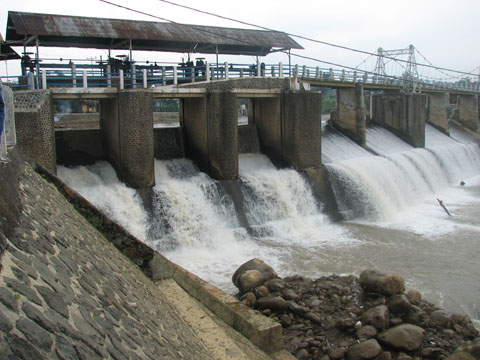
bendung Katulampa
Kunjungan terakhir adalah ke bendung Katulampa. Menilik sejarahnya akan membawa kita ke tahun 1872, dimana banjir besar melanda kota Batavia, terutama di daerah Molenvliet (sekarang Harmoni), Rijswijk (sekarang jl. Veteran) dan Noordwijk (sekarang jl. Juanda). Hal ini membuat Van Ferkish memprakarsai pendirian bendung Katulampa. Dibangun sejak tahun 1889-1911, bendung ini sebenarnya digunakan untuk meninggikan permukaan air untuk masuk kedalam intake saluran irigasi, tapi selanjutnya berkembang menjadi banyak fungsi, salah satu yang terpenting yaitu sebagai FWS (flood warning system) bagi kota Jakarta. Bendung raksasa berukuran panjang 105,9 m dengan lebar mercu 91,9 m dan lebar intake 14 m ini memiliki 3 pintu penguras bendung berukuran 4×2 m, 1 pintu penguras bendung berukuran 1,5×2 m, ditambah 5 pintu intake bendung berukuran 2×1 m. Besarnya daerah irigasi yang dilayani bendung ini sebanding dengan dimensinya, luas fungsionalnya mencapai 449 Ha dengan perincian 139 Ha di kota Bogor, 236 Ha di Kabupaten Bogor, dan 72 Ha di kota Depok. Berbicara tentang fungsinya sebagai FWS tidak akan lepas dari pengalaman banjir luar biasa tahun 2007. Saat itu, muka air di atas mercu tercatat 240 cm dan sebanyak 653 m3 air mengalir menuju kota Jakarta, keadaan seperti itu berlangsung selama 8-9 jam.
IRRIGATION
Case studies - cage culture in irrigation canals
Indonesia/Java
The culture of carp extensively in the drainage and sewage canals in Indonesia has been successful for many years. This system relies almost entirely on the natural food web to provide food for the carp. This practice is rather an exception to conventional cage culture which usually relates to a system relying on formulated feeds, high capital investment and little contribution from natural production.
Vaas and Saachlan (1956) reported the growth of carp in cages in canals running through the centre of Bandung, West Java. This practice was thought either to have originated either in Japan, or from the practice of holding fish in the canals before sale, during which time increases in weight were noticed. In this particular study, the canals were 4–5 m in width with a minimum water depth of 30–40 cm, and acted as an open sewer for human and kitchen wastes. The rectangular cages were stocked with common carp 8–12 cm long. These fish reached weights of 50– 75 kg in 2–3 months with little supplementary feeding, usually no more than some rice bran or stale bread. Feeding in the cages tended to be opportunistic with the smaller fish consuming species of chironomid larvae and Oligochaetae. These organisms are found in large numbers in areas of high organic deposits in both tropical and temperate waters (Pearson and Rosenberg, 1978; Gowen and Bradbury, 1987; Redding, 1988), and may form part of the natural diet of many omnivorous and detritivorous fish.
Later studies by Costa-Pierce and Effendi (1988) on cage culture in Cianjur, Indonesia, indicated that the present method of producing carps in cages in canals was both financially successful (Table 20) and did not interfere with the flow rates in the canals. Initially, however, the cages were floating, but by the late 1960s irrigation authorities noted that not only were the flow rates of water to the paddy fields affected but also the number of cages in the system was so large that they were causing flooding during the rainy season. From the ban on floating cages in the early 1970s evolved the in-bottom bamboo cages which are used today.
Cages of 3 x 4 m are dug into the bottom of the canal and left for a period of six months, during which time accumulated debris is occasionally swept off the top of the cage (Figure 9). It was found that the cage served three functions; the production of carp, collection of sand (which has a commercial value), and the direct processing of sewage. Fish were stocked at 1 kg/m3 at a size of 8–10 fish per kg. In six months they had reached a size of 1 kg, and thus two crops a year can be grown. One cage can produce 60 kg of fish per year without addition of food, and also produces 1.5m3 of sand a week during the rains. The economic analysis is shown in Table 20 with a return over total costs of I.RP. 40 950. It should be noted, however, that this system operates in an environment subject to exceptionally high organic loading, which largely accounts for its success.
| Economic variable | Unit | Cost per unit | Quantity per yr | Total Cost |
|---|---|---|---|---|
| Gross receipts | ||||
| a. Fish prodn. | kg | 1600 | 60 | 96000 |
| b. Sand | m3 | 2000 | 48 | 96000 |
| Total gross receipts | 192000 | |||
| Variable costs | ||||
| a. Fingerlings (100–125g) | kg | 1800 | 20 | 36000 |
| b. Feed | kg | 480 | 0 | 0 |
| c. Labour | Man-days | 2000 | 3 | 6000 |
| d. Repair and Maintenance | 36350 | |||
| @ 50% Fixed costs | ||||
| Total variable costs | 78350 | |||
| Fixed Costs | ||||
| a. Bamboo | piece | 1500 | 40 | 60000 |
| b. Nails | kg | 1500 | 2 | 3000 |
| c. Wood 5×7×5m | Board | 1700 | 1 | 1700 |
| d. Labour | Man-days | 2000 | 4 | 8000 |
| Total Fixed costs | 72700 | |||
| Total Costs | 151050 | |||
| Return above variable costs | 113650 | |||
| Return above total costs | 40950 | |||
Costs are in Indonesian Rupees (Rp)

Figure 9 Submerged cage used in Cota Cianjur, Indonesia (Costa-Pierce and Effendi, 1988)
Egypt
Much of the information relating to fish production in irrigation canals from aquaculture, little as it is, comes from recent experimental work in Egypt. An interesting example are investigations carried out in the Nile river and associated irrigation canals.
In 1983 it was estimated that 13% of the protein intake of the population of Egypt was fish protein (Jauncey and Stewart 1987). With a population of 50 million (1986), rising to 70 million in the year 2000 (a population growth rate of 2.6%), and a per capita consumption of fish of between 4.7 – 6.2 kg/yr, by the year 2000 there is likely to be a shortfall in fish production from inland and maritime fisheries of 450 000 tonnes per year (Jauncey and Stewart, 1987).
Fish production from aquaculture in 1986 was estimated to contribute 106 000 tonnes to the total Egyptian fish production (Sadek 1988). Traditional areas for production include extensive ‘howash’ enclosures, seepage ponds, irrigation systems and village ponds. The average fish yield varies between 760 – 2 500 kg/ha depending on the intensity of the operation. In addition, cage culture of mullet and tilapia in Lake Quarun and the governmental fish farm near Lake Manzala are expected to produce 1 300 kg/ha/yr (Sadek, 1988). However if demand for fish and the rate of population increase continues there will be increasing pressure to increase aquaculture production, since the maximum sustainable yield (MSY) of the fisheries sector has already been exceeded.
Egypt possesses approximately 50 000 km of irrigation and drainage canals, of which approximately 3 532 km are of a suitable size for aquaculture. The potential for some form of aquaculture in these waters is considerable according to Jauncey and Stewart (1987).
However, a major constraint to large-scale development lies in the government ban of the use of agricultural land and fresh water from the Nile irrigation canals for commercial aquaculture. Brackish and saline drainage waters are available for aquaculture, but these waters have many associated risks, including the runoff of pesticides from agriculture and pollution from industrial and mining activities.
An experimental cage culture system has been set up in the Nile river and irrigation canals in the El Behera Governorate, approximately 100 km from Alexandria (Nour, pers.comm.). The project aims to produce tilapia, common carp and grey mullet in polyculture, and catfish in monoculture systems. The cages are set in the Nile river since the main supply canals are not available for use at this stage, due to concerns over the possible effect on flow rates.
The cages are made by farmers, from local materials such as bamboo, and are stocked with fingerlings donated by the University of Alexandria, who are involved in running the project. Fingerlings of 20–30 g are stocked at a density of approximately 10 kg/m3 in March/May (i.e. 500–700 fingerlings per 2 m × 4 m × 2 m cage). The species composition of each cage is: carp (60%), tilapia (10–20%), and grey mullet (10%). These are fed a pelleted diet containing 25% protein at a rate of 2% body weight weekly (at a cost of LE. 300 per tonne).
The fish reach market size (tilapia 200 g, carp 500 g, grey mullet 150 g) by October/November, at which time they are harvested. The main constraint to this project is the high mortality experienced in the capture and transportation of fingerlings from the earth-lined hatchery ponds.
The number of cages in this area has risen from 10 to 600 in three years and are very popular with the local farmers, who can expect to obtain an average profit of US$ 200 from an initial outlay of US$ 80.
Ishak (1982), and Ishak et al. (1986) described similar experimental culture of Oreochromis niloticus in the Nile irrigation canals. Cages with a volume of 3m3 were fixed in running and static water canals and stocked with 100 individual fish of approximately 30 g. After feeding at a rate of 5% body weight per day for 150 days, the fish in flowing canals had reached a weight of 152 g, whereas the fish in static water had only reached 76 g in weight. The same authors also showed that using 4m3 cages two crops of fish could be obtained per year with a growout period of 105 days. In this example a total production of 40 kg/m was obtained in a period of seven months (equivalent to 700 t/ha/yr). Approximately 100 tonnes could be produced per annum from an area of 1 ha of cages (each 12–16m2).
Thailand
In Thailand experimental work has been carried out in producing the freshwater prawn Macrobrachium rosenbergii in different culture systems. Since the construction of dams for irrigation purposes the wild stocks have declined as the natural migration and spawning routes were obstructed, and the waters became increasingly polluted with both industrial and agricultural effluents (Menasveta & Piyatiratitivokul, 1982). The increasing market for prawns has stimulated interest in the possible use of alternative culture systems for ongrowing this species.
Nylon-screen net cages (2 m × 3 m × 1.8 m) (Figure 10), with a mesh size of 16/cm2 were submerged in an irrigation canal at a depth of 1.2 m in the Rangsit irrigation area. The other systems used for comparison were an earthen pond (30 m × 30 m) with a depth of 1.5 m, and a long ditch in an orchard (1.2 m × 100 m × 1.2 m, depth 0.9m).

Figure 10 Schematic illustration of a simple fixed cage used for prawn culture in canals in Thailand Stocking density at the start of the trial was 5 six-week old prawns/m2. They were fed a compounded diet at the rate of 5% body weight per day, containing 40% protein, 20% carbohydrate, 15% fat, 20% ash, and 5% moisture. The results showed that after 6 months, although the growth rate in the ponds was greatest, the survival rate was highest in the cages (Table 21). Production was highest in the earth ponds, at 210 kg/rai (0.16ha). The cages performed second best, with 138 kg/rai, and production from the ditch was 78 kg/rai. This suggested that the culture of prawns in irrigation canals is economically viable despite the high turbidity of the water. However, usually such canals are used for transport and the water level is not kept constant. This system warrants further economic analysis in terms of the possible increased production from canals which have already been constructed, as opposed to the high cost of excavating earthen ponds. In addition, if cooperation between the irrigation authorities and the aquaculturists could be attained, to remove the constraint to aquaculture of water level fluctuations in the canals, then the full production potential of the canals could be realised.
Hiranwat et al. (1985) stocked irrigation canals with grass carp and Puntius gonionotus, as a weed control measure. After four months the fish were harvested. The average individual weight of the grass carp had increased from 48 g to 631 g in this period, whilst that of the Puntius had risen from 23 g to 81 g.
7.2.4 Pen Culture
An alternative to cage culture, is to produce fish in a more extensive system, in which the canal is blocked off at intervals by barriers to form a series of pens. This system may best be utilized for polyculture, as this has been shown to be the best technique to make full use of the natural resources in an extensive or semi-intensive system (however, it is possible that an irrigation system may not exhibit the diversity of niches required for efficient polyculture). In such a system, inputs are minimal, comprising seed fish, regular monitoring of the site for water quality and predators, and probably some supplementary feeding (although this latter will be dependant on the natural productivity of the system, and the stocking densities employed). The carrying capacity can be calculated using the same equation as that for caged fish, ignoring the allowance for the transmission factor (see Appendices 2 and 3) if the pen stretches the whole width of the canal. However it must be stressed that every canal system is different, and the water quality and oxygen content should be monitored carefully before any decisions on species and stocking rates are made.
| Culture systems mnths | Initial stocking | Survival | Survival (%) | Production (kg) | Production in k g / r a i 1 / 6 |
|---|---|---|---|---|---|
| Pond | 12000 | 5760 | 48.0 | 315 | 210 |
| Cage | 120 | 63 | 52.5 | 1.55 | 138 |
| Ditch (Canal) | 600 | 211 | 35.2 | 5.55 | 74 |
Notes:
1. 1 rai = 0.16 ha
Whilst pens and cages are similar in that the sides of the enclosure are man-made, pens differ in that the base of the enclosure is the substrate itself, rather than an artificial structure such as a net or wooden mesh. Pens have certain advantages over cages, perhaps the principal one being access to benthic organisms, providing an additional food source (Beveridge, 1984). They do, however, suffer a major disadvantage in that they are difficult to harvest. Pens generally are larger than cages, and are less suited to intensive culture.
Low-cost materials such as bamboo stakes or woven rush mesh are used as barriers to prevent the escape of larger fish. However, to prevent the entry of predatory species it is necessary, in the earlier stages at least, to use small meshed netting. In fact, it is safer to use netting throughout the culture cycle, as bamboo walls etc are more likely to be breached.
In addition to the growout of fish, pen culture could be useful for nursing young fish as part of a stock enhancement programme. After raising them for a few months in an enclosed area of canal, the fish could be released to the rest of the system once large enough to escape potential predators.
Irrigation
ENGINEERING ASPECTS OF IRRIGATION SYSTEMS
Since this review concerns the potential of irrigation canals for fisheries and aquaculture, the following section outlines the general features of irrigation systems. Those most commonly found in developing countries are generally in the form of unlined and lined open canals.
The design of these systems follows a common pattern, and many similarities are to be found between irrigation systems in widely separated parts of the world. For this reason, the following description of the characteristics of irrigation schemes is a general one, and the reader should refer to Jones (1981), Mather (1983) and Michael (1978) for more information on the general principles of irrigation engineering.
2.1 Surface irrigation
2.1.1 Unlined canals
Surface irrigation systems usually consist of a network of open canals, which may or may not be lined to prevent seepage and/or erosion. It is usual in developing countries for them to be unlined since this type of canal is easy to build, with low capital costs, and can be easily maintained by unskilled labourers.
Canals are designed to carry a specified discharge without erosion and traditionally have a trapezoidal shape. The basic elements of open canals are shown in Figures 1 and 2.
Canal banks - These generally have a slope of 1:1.5. However this ratio is usually increased to 1:2 with sandy soils and decreased to 1:1 with clay soils.
Canal gradient - This depends on the lie of the land but normally the slope would be approximately 0.1%. Slopes of less than 0.05% often lead to siltation in the canal. Water velocities in canals with steeper gradients can be controlled by drop structures or by building up the canal bed. Michael (1978) suggests the following velocities for various soil textures:
| Soil Texture | Max. recommended velocity |
|---|---|
| cm/s | |
| Bare canals | |
| Sand and silt | 45 |
| Loam, sandy loam, silt loam | 60 |
| Clay loam | 65 |
| Clay | 70 |
| Vegetated Canals | |
| Poor vegetation | 90 |
| Fair vegetation | 120 |
| Good vegetation | 150 |
Velocities greater than these should be avoided if erosion is to be prevented.
Canal Cross Sections - It is thought that the most efficient cross section for open canals is a semi circle, since with this form of construction the wetted perimeter is at a minimum and the hydraulic radius is at a maximum (hydraulic radius is cross sectional area divided by the wetted perimeter). A high hydraulic radius is recommended for canals carrying larger flows. However, semi-circular construction is only possible in small sized lined canals or enclosed pipework. Consequently, most unlined canals have a trapezoidal cross section (Figures 1, 2) to accommodate high flows.

Figure 1 Elements of an open channel
Key:
T - top width of the channel
t - width of surface when water is at depth d
D - depth of channel after free board is added
d - depth of flow in channel
c - wetted sides of channel
f - free board
l - angle between sloping sides of the horizontal

Figure 2 Typical cross-section of an unlined field canal

Figure 3 Cross-section of a brick-lined channel
In lined canals the cross-section is often rectangular. These canals occupy less of the agricultural land, but are also is more costly to construct (Figure 3).
Unlined canals, whilst attractive because of their low construction costs, have a number of disadvantages which may have serious consequences for crop production, and which also have implications for fish production. These problems are examined in section 3.
2.1.2 Lined Canals
These canals are normally lined with concrete, brick or stone. Other types of lining more recently used include polythene films, bitumous mixtures, soil cement, chemical sealants and impervious earth materials (Michael, 1978). These have a limited life, however, and are susceptible to damage by livestock and excessive water velocity. Concrete linings, although costly, have a longer lifespan with minimal repair and maintenance costs.
Canal banks - The slope of the banks can be greater in lined canals than in earth canals, but should not exceed a slope of 1:1, unless the concrete is hand placed and the canal over 60 cm in depth. Brick, flat clay tile and stone lined canals are recommended for water courses where the velocity exceeds 30 cm/s. A typical cross-section is shown in Figure 3.
2.1.3 Tubewell irrigation systems
In certain areas of the world there are extensive aquifers; Bangladesh is a prime example, and much of the irrigated area is supplied by numerous tube wells which tap the underground water resources. These wells each supply only small areas, a few hectares at most. Water is pumped from the well on demand, and is distributed to the fields by a series of tertiary and quaternary canals. In such systems there is no potential for fish culture in the irrigation canals.
2.2 Subsurface irrigation
2.2.1 Underground pipeline irrigation
There are several advantages in using pressurised underground systems compared to that of open canals. Pipes take less land out of cultivation and do not interfere with farm operations. They are essentially leakproof and have a long life, with little maintenance and are not easily damaged. Water is applied to the crops by sprinkler or trickle systems and little labour is involved. Water use is very efficient, although costly. The main design elements of an underground pipeline system are shown in Figure 4. The increasing use of pressurised systems, especially in developed countries and for high value crops, may considerably reduce the fisheries potential of irrigation systems (particularly at the local level).

Figure 4 The main design elements of an underground pipeline system
2.3 Generalised surface irrigation scheme
This section describes the typical layout and design characteristics of an unlined–canal water distribution system. It is based on existing projects in Indonesia (courtesy Silsoe College, Bedford, UK) and the Farahaane Irrigation Rehabilitation Scheme in Somalia (courtesy of Sir M McDonald and Partners Ltd Cambridge, UK).
2.3.1 Distribution system
Figure 5 shows the layout of a standard scheme (this example being in Indonesia), and Figure 6 an irrigation system in Sudan, which is a variation on this theme.
Generally, primary canals distribute water from the source to the secondary canals which in turn supply the tertiary canals. The water then passes to the quaternary or field canals and so to the crops. The dimensional and flow characteristics for each category of canal are given in Table 3. The data is drawn from several examples of irrigation systems, and is therefore generalised.
| Canal type Comments | Bed width* (m) | Bank Slope | Depth (m) | Flow 1/s |
|---|---|---|---|---|
| Primary | 5–6 | 1.5–2 | 1–1.2 | 800 |
| Secondary | 2–3 | 1.5–2 | 0.5–0.7 | 20–400 |
| Tertiary | 0.01–0.1 | 1.0 | 0.1 | 0–20 |
| Quaternary | " | " | " | " |
* Note: this refers to the bed width of the channel, not thewidth at its surface
Flow rates are based on a flow requirement of 2 litres per second per hactare for a rice crop.

Figure 5 Layout of an irrigation scheme (e.g. Indonesia)

Figure 6 The Gezira Irrigation Scheme, Sudan (gravity flow through unlined earth canals)
2.3.2 Canal lengths
With irrigation systems being standardised to such a high degree, it is possible to estimate, quite accurately, the length of each category of canal in a given system. It is obviously important to know this if estimates, at anything but the individual level, of the aquaculture or fisheries potential of irrigation systems are to be made. Based on a standard 5 000 hectare project (a common size), for each unit of 1 000 hectares the average canal lengths in each category are as follows;
| Primaries | 2.5km |
| Secondaries | 10km |
| Tertiaries | 100km |
| Quaternaries | 400km |
Given these formulae, and assuming a standard width for each category of canal, it is possible to make a very rough estimate of the water area of an irrigation system of a given size.


THREE GORGES DAM 2


Index
A: Spill Way. B: Power Plant (right bank). C: Power Plant (left bank). D: Dam View Site.
E: Tanzhilin Terrace. F: Ship Locks.(5 grade) G: Temperary Shiplock. H: Ship Lift.
I: 185M Terrace. J: Memory Park. K: Dyke (Dike). L: Xiling Bridge.
M1: Yangtze River (Upper). M2: Yangtze River (Down).
N: Fenghuang Hill Park (Zigui County). O: Shiplock View Site (Zashou, Dam Head).
P: Dam Top. Q: The TGP Center hotel. R: Zigui Town.

Senin, 16 Februari 2009

Kamis, 05 Februari 2009
Semester civil eng. and informatics
TRANSLATE INTO ENGLISH !! ..
Suatu hari di musim panas, kami pergi melihat air terjun, dimana jaraknya sangat jauh dan juga jalannya sangat jelek, hal-hal bodoh yang kami lakukan adalah kami pergi tanpa PEMANDU jalan sehingga kami tersesat dan tidak menemukan jalan pulang. Akhirnya kami ditemukan oleh tim SAR dalam keadaan kelaparan dan tidak mandi selama 4 hari.
and then Learning about :
1. Verb and non verb
2. writing for vidio ( informatics) in " youtube"
3. about DIAGRAM " WAN ", etc......................( informatics )
4. about DIAGRAM " Three gorges Dam in china ", etc.......................( civil eng. )
Suatu hari di musim panas, kami pergi melihat air terjun, dimana jaraknya sangat jauh dan juga jalannya sangat jelek, hal-hal bodoh yang kami lakukan adalah kami pergi tanpa PEMANDU jalan sehingga kami tersesat dan tidak menemukan jalan pulang. Akhirnya kami ditemukan oleh tim SAR dalam keadaan kelaparan dan tidak mandi selama 4 hari.
and then Learning about :
1. Verb and non verb
2. writing for vidio ( informatics) in " youtube"
3. about DIAGRAM " WAN ", etc......................( informatics )
4. about DIAGRAM " Three gorges Dam in china ", etc.......................( civil eng. )
Selasa, 13 Januari 2009


PIERS


http://www.google.co.id/search?hl=id&q=related:www.ftsl.itb.ac.id/wp-content/uploads/2007/09/SL-1101-M3-Sipil.pdf&start=10&sa=N
http://www.pu.go.id/Ditjen_Prasarana%20Wil/referensi/nspm/petunjuk134.pdf
Sabtu, 03 Januari 2009
INFORMATICS
Computer Vocabulary
1. BIOS - BIOS - basic input/output system - The BIOS tells the computer how to boot up properly and load the operating system.
2. Central processing Unit (CPU) - The "brain" of the computer.
3. Random Access Memory(RAM) - temporary memory that is wiped clean when the computer reboots, or there is a power failure.
4. Read Only Memory(ROM)- permanent memory that cannot be changed. This memory was created when the chip was manufactured.
5. Hard disk - magnetic storage inside of a a computer used for storing files for long term use.
6. Byte - (8 bits) Used to measure storage space.
7. Bit - one binary digit that is represented either as a 0 or 1, or an "on" or "off" state. Bits are used to measure transfer speed.
8. Hardware - part of the computer that you can physically touch
9. Software - A program, operating system, or code that tells the computer what to do.
10. Pixel - Short for picture element. A pixel is the smallest unit of visual information used to build an image on a computer or tv screen.
11. Operating System- Computer software that controls the basic functions of your computer(IE- Windows 98 orXP, MacOS, UNIX, Linux)
12. Virus - program that interferes with the normal use of a computer
13. ASCII (plain text)- American Standard Code for Information Interchange - This ia a file format understood by all computers.
1. Networking Vocabulary
1. Server - Powerful computer that shares it's files/applications with many other computers
2. Workstation - Computer for running applications from server
3. Bandwidth - The amount of data a cable can carry.
4. LAN - Local Area Network - Computers connected together in one building or general area
5. Firewall - a barrier to keep destructive forces away from your personal computer data.
6. Proxy server - used to filter out content on the internet and to speed up internet usage.
7. WAN - Wide Area Network(All of Wake County school's computers)
8. Packet - A block of information with a header, data, and trailer that serves as the way information moves on a network.
9. ISP - (Internet service provider) Companies who provide internet access to their customers. (IE-AOL, Earthlink)
10. WWW - (World wide web) A slang term for the internet. The internet is like a huge spider's web that connects a bunch of computers.
11. URL - (Uniform Resorce Locator) The address for a website. (IE- www.microsoft.com)
12. HTTP - (Hyper Text Transfer Protocol) The way that your computer makes connections to websites.
13. FTP - (File Transfer Protocol) The way your computer makes connections to a web server for uploading files.
--------------------------------------------------------------------------------------------------------------------------------------------------------------------------
My friend was on duty in the main lab on a quiet afternoon. He noticed a young woman sitting in front of one of the workstations with her arms crossed across her chest, staring at the screen. After about 15 minutes he noticed that she was still in the same position, only now she was impatiently tapping her foot. He asked if she needed help and she replied "It's about time! I pressed the F1 button over twenty minutes ago!"
After experiencing difficulties with his computer, a poor, incognizant user called the system maker's technical support line for assistance...
• Technician: Hello. How can I help you today?
• Customer: There's smoke coming from the power supply on my computer.
• Technician: Looks like you need a new power supply.
• Customer: No, I don't! I just need to change the startup files.
• Technician: Sir, what you described is a faulty power supply. You need to replace it.
• Customer: No way! Someone told me that I just had to change the system startup files to fix the problem! All I need is for you to tell me the right command.
For the next ten minutes, in spite of the technician's efforts to explain the problem and its solution, the customer adamantly insisted that he was right. So, in frustration, the technician responded...
• Technician: I'm sorry. We don't normally tell our customers this, but there's an undocumented DOS command that will fix the problem...
• Customer: I knew it!
• Technician: Just add the line "LOAD NOSMOKE.COM" at the end of the CONFIG.SYS file and everything should work fine. Let me know how it goes.
About ten minutes later, the technician received a call back from the customer.
• Customer: It didn't work. The power supply is still smoking...
• Technician: Well, what version of DOS are you using?
• Customer: MS-DOS 6.22.
• Technician: Well, that's your problem. That version of DOS doesn't include NOSMOKE. You'll need to contact Microsoft and ask them for a patch. Let me know how it all works out.
When nearly an hour had passed, the phone rang again...
• Customer: I need a new power supply.
• Technician: How did you come to that conclusion?
• Customer: Well, I called Microsoft and told the technician what you said, and he started asking me questions about the make of the power supply.
• Technician: What did he tell you?
• Customer: He said my power supply isn't compatible with NOSMOKE.
1. BIOS - BIOS - basic input/output system - The BIOS tells the computer how to boot up properly and load the operating system.
2. Central processing Unit (CPU) - The "brain" of the computer.
3. Random Access Memory(RAM) - temporary memory that is wiped clean when the computer reboots, or there is a power failure.
4. Read Only Memory(ROM)- permanent memory that cannot be changed. This memory was created when the chip was manufactured.
5. Hard disk - magnetic storage inside of a a computer used for storing files for long term use.
6. Byte - (8 bits) Used to measure storage space.
7. Bit - one binary digit that is represented either as a 0 or 1, or an "on" or "off" state. Bits are used to measure transfer speed.
8. Hardware - part of the computer that you can physically touch
9. Software - A program, operating system, or code that tells the computer what to do.
10. Pixel - Short for picture element. A pixel is the smallest unit of visual information used to build an image on a computer or tv screen.
11. Operating System- Computer software that controls the basic functions of your computer(IE- Windows 98 orXP, MacOS, UNIX, Linux)
12. Virus - program that interferes with the normal use of a computer
13. ASCII (plain text)- American Standard Code for Information Interchange - This ia a file format understood by all computers.
1. Networking Vocabulary
1. Server - Powerful computer that shares it's files/applications with many other computers
2. Workstation - Computer for running applications from server
3. Bandwidth - The amount of data a cable can carry.
4. LAN - Local Area Network - Computers connected together in one building or general area
5. Firewall - a barrier to keep destructive forces away from your personal computer data.
6. Proxy server - used to filter out content on the internet and to speed up internet usage.
7. WAN - Wide Area Network(All of Wake County school's computers)
8. Packet - A block of information with a header, data, and trailer that serves as the way information moves on a network.
9. ISP - (Internet service provider) Companies who provide internet access to their customers. (IE-AOL, Earthlink)
10. WWW - (World wide web) A slang term for the internet. The internet is like a huge spider's web that connects a bunch of computers.
11. URL - (Uniform Resorce Locator) The address for a website. (IE- www.microsoft.com)
12. HTTP - (Hyper Text Transfer Protocol) The way that your computer makes connections to websites.
13. FTP - (File Transfer Protocol) The way your computer makes connections to a web server for uploading files.
--------------------------------------------------------------------------------------------------------------------------------------------------------------------------
My friend was on duty in the main lab on a quiet afternoon. He noticed a young woman sitting in front of one of the workstations with her arms crossed across her chest, staring at the screen. After about 15 minutes he noticed that she was still in the same position, only now she was impatiently tapping her foot. He asked if she needed help and she replied "It's about time! I pressed the F1 button over twenty minutes ago!"
After experiencing difficulties with his computer, a poor, incognizant user called the system maker's technical support line for assistance...
• Technician: Hello. How can I help you today?
• Customer: There's smoke coming from the power supply on my computer.
• Technician: Looks like you need a new power supply.
• Customer: No, I don't! I just need to change the startup files.
• Technician: Sir, what you described is a faulty power supply. You need to replace it.
• Customer: No way! Someone told me that I just had to change the system startup files to fix the problem! All I need is for you to tell me the right command.
For the next ten minutes, in spite of the technician's efforts to explain the problem and its solution, the customer adamantly insisted that he was right. So, in frustration, the technician responded...
• Technician: I'm sorry. We don't normally tell our customers this, but there's an undocumented DOS command that will fix the problem...
• Customer: I knew it!
• Technician: Just add the line "LOAD NOSMOKE.COM" at the end of the CONFIG.SYS file and everything should work fine. Let me know how it goes.
About ten minutes later, the technician received a call back from the customer.
• Customer: It didn't work. The power supply is still smoking...
• Technician: Well, what version of DOS are you using?
• Customer: MS-DOS 6.22.
• Technician: Well, that's your problem. That version of DOS doesn't include NOSMOKE. You'll need to contact Microsoft and ask them for a patch. Let me know how it all works out.
When nearly an hour had passed, the phone rang again...
• Customer: I need a new power supply.
• Technician: How did you come to that conclusion?
• Customer: Well, I called Microsoft and told the technician what you said, and he started asking me questions about the make of the power supply.
• Technician: What did he tell you?
• Customer: He said my power supply isn't compatible with NOSMOKE.
Jumat, 02 Januari 2009
VIRUS ( Informatics )
http://www.youtube.com/watch?v=mXfb7aZVc0c&feature=related
Please make writing in the classroom after you watch this film ( quiz )
And how can virus infect computer ??
Please make writing in the classroom after you watch this film ( quiz )
And how can virus infect computer ??
Jumat, 19 Desember 2008
QUIZ Civil engineering
- http://www.youtube.com/watch?v=PcOGmI9gz3A
http://www.youtube.com/watch?v=cEL7yc8R42k&NR=1
http://www.youtube.com/watch?v=kiHyTW2xpmk&NR=1 - http://www.youtube.com/watch?v=-yLZYETYlmM
- http://www.youtube.com/watch?v=tqKmDYzzyCI&feature=channel
After you watch this film, please make writing and diagram this topic ( lesson ) in the classroom ( after new year )
thx


Civil Engineering
Please open this site :
- http://www.youtube.com/watch?v=fdZXZRCnh1E
- http://www.youtube.com/watch?v=-NUycoFY_00&NR=1
- http://www.youtube.com/watch?v=NwFGyzllCJg&feature=related
After you watch the film, well please give your opinion in the classroom ( discuss )!
| Index A: Spill Way. B: Power Plant (right bank). C: Power Plant (left bank). D: Dam View Site. |
| |

Selasa, 16 Desember 2008
COMMENT FOR INFORMATICS STUDENTS
Untuk mahasiswa/i Informatika STTH yang ada bloggernya ( cari pada mengenai saya dan buka file * lihat profil lengkapku * )
Inilah daftar mahasiswa/i yang telah membuat blogger.
Untuk selanjutnya yang belum lengkap tentang writing / journal, agar dapat dibuat penulisan atau journal secepatnya.
Dan JANGAN LUPA PADA SETIAP BLOGGER YANG DIBUAT HARUS DISERTAKAN NAMA LENGKAP SERTA NO.INDUK MAHASISWA/I.
Inilah daftar mahasiswa/i yang telah membuat blogger.
Untuk selanjutnya yang belum lengkap tentang writing / journal, agar dapat dibuat penulisan atau journal secepatnya.
Dan JANGAN LUPA PADA SETIAP BLOGGER YANG DIBUAT HARUS DISERTAKAN NAMA LENGKAP SERTA NO.INDUK MAHASISWA/I.
Senin, 15 Desember 2008
Civil Engineering


1. PENDAHULUAN
| Energi air adalah energi yang telah dimanfaatkan secara luas di Indonesia yang dalam skala besar telah digunakan sebagai pembangkit listrik. Beberapa perusahaan di bidang pertanian bahkan juga memiliki pembangkit listrik sendiri yang bersumber dari energi air. Di masa mendatang untuk pembangunan pedesaan termasuk industri kecil yang jauh dari jaringan listrik nasional, energi yang dibangkitkan melalui sistem mikrohidro diperkirakan akan tumbuh secara pesat. |
2. POTENSI AIR SEBAGAI SUMBER ENERGI
| Potensi air sebagai sumber energi terutama digunakan sebagai penyedia energi listrik melalui pembangkit listrik tenaga air maupun mikrohidro. Potensi tenaga air di seluruh Indonesia diperkirakan sebesar 75684 MW. Potensi ini dapat dimanfaatkan untuk pembangkit tenaga listrik dengan kapasitas 100 MW ke atas dengan jumlah sekitar 800. Banyaknya sungai dan danau air tawar yang ada di Indonesia merupakan modal awal untuk pengembangan energi air ini. Namun eksploitasi terhadap sumber energi yang satu ini juga harus memperhatikan ekosistem lingkungan yang sudah ada. Pemanfaatan energi air pada dasarnya adalah pemanfaatan energi potensial gravitasi. Energi mekanik aliran air yang merupakan transformasi dari energi potensial gravitasi dimanfaatkan untuk menggerakkan turbin atau kincir. Umumnya turbin digunakan untuk membangkitkan energi listrik sedangkan kincir untuk pemanfaatan energi mekanik secara langsung. Pada umumnya untuk mendapatkan energi mekanik aliran air ini, perlu beda tinggi air yang diciptakan dengan menggunakan bendungan. Akan tetapi dalam menggerakkan kincir, aliran air pada sungai dapat dimanfaatkan ketika kecepatan alirannya memada. Pembangkit listrik mikrohidro mengacu pada pembangkit listrik dengan skala di bawah 100 kW. Banyak daerah pedesaan di Indonesia yang dekat dengan aliran sungai yang memadai untuk pembangkit listrik pada skala yang demikian. Diharapkan dengan memanfaatkan potensi yang ada di desa-desa tersebut dapat memenuhi kebutuhan energinya sendiri dalam mengantisipasi kenaikan biaya energi atau kesulitan jaringan listrik nasional untuk menjangkaunya. Energi air yang dimanfaatkan di Indonesia pada umumnya dalam skala yang besar (PLTA). Ada beberapa kontroversi untuk menggolongkan PLTA sebagai sumber energi terbarukan, karena dampak negatifnya terhadap kondisi lingkungan. Bendungan besar yang digunakan dapat memperlambat debit aliran sungai secara signifikan sehingga mempengaruhi ekosistem sungai. Suplai air untuk keperluan lainnya pun juga terkena dampak. Dalam konstruksi bendungan yang membutuhkan lahan yang luas seringkali harus mengkonversi ekosistem di daerah aliran. Berbeda dengan pemanfaatan energi mikrohidro, sehubungan dengan skala yang tidak terlalu besar dampak terhadap lingkungan tidak terlalu besar.
|
3. PEMANFAATAN ENERGI AIR MENGGUNAKAN KINCIR
| Pemanfaatan energi air dalam skala kecil dapat berupa penerapan kincir air dan turbin. Dikenal ada tiga jenis kincir air berdasarkan sistem aliran airnya, yaitu : overshot, breast-shot, dan under-shot. (Animasi 5.1.) Pada kincir overshot, air melalui atas kincir dan kincir berada di bawah aliran air. Air memutar kincir dan air jatuh ke permukaan lebih rendah. Kincir bergerak searah jarum jam. Pada kincir breast-shot, kincir diletakkan sejajar dengan aliran air sehingga air mengalir melalui tengah-tengah kincir. Air memutar kincir berlawanan dengan arah jarum jam. Pada kincir under-shot, posisi kincir air diletakkan agak ke atas dan sedikit menyentuh air. Aliran air yang menyentuh kincir menggerakkan kincir sehingga berlawanan arah dengan jarum jam.
|
|
Animasi 5.1. Jenis kincir berdasarkan posisi aliran air
|
| Daya yang dapat diberikan aliran air melalui kincir atau turbin berbanding lurus dengan tinggi permukaan dan debit air. Untuk itu daya turbin dapat dihitung dengan rumus berikut:
Dimana : η = efisiensi sistem (-) σ = berat air persatuan volume (N/m3) Q = debit air (m3/det) h = ketinggian permukaan (m) Bhp = daya yang diberikan aliran air melalui kincir (Watt) |

Tabel 5.1. Karakteristik dari kincir air
| Karakteristik | Jenis Kincir | ||
| Over-shot | Breast-shot | Under-shot | |
| 1. Ketinggian permukaan air, Head (h), m | 3-12 | 2-5 | 0.4-3.0 |
| 2. Debit air, Q (m3/det) | - | 0.3-3.0 | 0.2-5.0 |
| 3. Diameter kincir D (m) | 2.5-10 | 5.5-8.5 (D=h+3.5) | 2-9 (D=3h sampai 5h) |
| 4. Kecepatan peripheral U (m/det) | 1.5-2 | 1.4-2 | - |
| 5. RPM | 3-25 | 3-7 | 2-12 |
| 6. Efisiensi Max. (%) | 65-80 | 60-75 | 60-70 |
| Contoh Soal 5.1. Kincir air “overshot” Suatu suplai air dengan ketinggian permukaan h= 5 m dan debit Q = 0.3 m3/det akan digunakan dengan melalui kincir air jenis over-shot yang berdiameter D = 4 m. Jika kincir berputar pada N = 5 RPM dan mempunyai 36 buah mangkuk disekeliling kincir. Tiap mangkuk terisi air tidak lebih dari separuh volumnya. Efisiensi sistem kincir adalah 60%. (a) Berapa volume tiap mangkuk yang diperlukan? (b) Bila luas penampang melintang mangkuk 0.1 m2, berapa lebar kincir yang diperlukan? (c) Berapa daya yang dihasilkan (d) Berapa kecepatan spesifik kincir tersebut?
| |||
| Jawab: (a) Volume mangkuk : (b) Lebar Kincir yang dibutuhkan : (c) Daya yang dihasilkan (Bhp)
(d) Kecepatan spesifiknya :
| |||
|


4. BEBERAPA JENIS TURBIN
| Diantara jenis turbin ada yang disebut turbin impuls dan turbin reaksi. Turbin impuls digerakkan melalui perubahan kecepatan (dan oleh karena itu momentum) dari air, sedangkan turbin reaksi berputar sehubungan dengan perbedaan tekanan yang dibangkitkan oleh air yang melalui sudu. Salah satu jenis turbin impuls adalah Roda Pelton (Kadir, 1980). Gambar memperlihatkan cara kerja Roda Pelton.
Kecepatan air dari nozlle pada Roda Pelton ini dapat dihitung dengan rumus : Dimana : V = kecepatan air pada nozlle (m/det) C = koefisien transmisi
Kecepatan titik pada lingkaran luar Roda Pelton biasanya dinyatakan dalam U = a V, dimana a=konstanta, sedangkan U sendiri adalah: Dimana : R = jari-jari Roda Pelton D = diameter Roda Pelton N = RPM Daya yang tersedia pada Roda Pelton juga dihitung dengan menggunakan persamaan daya kincir air. Nilai kecepatan spesifik (ηS) Roda Pelton, Turbin-Prancis dan Turbin Propeller unuk masing-masing efisiensi maksimum disajikan pada Tabel 5.2.
Tabel 5.2. Efisiensi maksimum dan kecepatan spesifik dari beberapa jenis turbin
| ||||||
| Gambar 5.1. www.capture3d.com/ |


| Contoh Soal 5.2. Turbin (Roda) Pelton Sebuah Roda Pelton dipakai untuk menghasilkan daya dengan menggunakan tenaga air dengan ketinggian 25 m. Apabila U= 0.45 V, V= kecepatan air pada nozlle dan turbin dirancang untuk N=300 RPM, maka
(a) Berapa diameter roda yang dibutuhkan dengan asumsi transmisi C = 0.95 (b) Bila nozlle mempunyai diameter 5 cm. Berapa debit aliran air (m3/det) ? (c) Berapa daya (Hp) yang bisa dihasilkan Roda Pelton pada efisiensi maksimumnya? (d) Berapa kecepatan spesifik Roda Pelton pada keadaan ini? | |||
| Jawab: (a) Dari rumus (3.141) : N = U / (η D) atau D = U / (η N) sedangkan U = 0.45 V
(b) Debit air Q = AV; diameter nozlle, D = 5 cm
(c) Daya yang dihasilkan, dengan efisiensi 0.88 maka:
(d) Sehingga kecepatan spesifik adalah
| |||
|


| Dua jenis turbin reaksi yang sering digunakan adalah Turbin Francis dan Kaplan . |
| Animasi 5.2. Turbin Francis http://www.jfccivilengineer.com/turbines.htm
|
| Gambar 5.2 . Turbin Kaplan (http://en.wikipedia.org/wiki/Water_turbine) |


3. PRINSIP PEMANFAATAN MIKROHIDRO
| Pemanfaatan aliran air dari sungai untuk pembangkit listrik (mikrohidro) adalah sebagai berikut. Air dari sungai dibendung, kemudian dialirkan melalui parit. Sebagian air dialirkan ke dalam bak penampungan dan sebagian lagi di alirkan untuk keperluan irigasi. Air dalam bak penampungan kemudian di saring dan dialirkan ke dalam bak penenang. Bak penenang berfungsi untuk menenangkan air agar tidak terjadi kumparan air yang dapat menyebabkan turbin bekerja tidak efisien. Air dalam bak penenang kemudian dialirkan melalui pipa-pipa besar yang disebut penstock yang menuju power house. Di dalam power house terdapat turbin dan generator. Putaran turbin menyebabkan generator berputar. Di dalam generator energi air yang digerakan turbin diubah menjadi energi listrik. Untuk menghasilkan tegangan yang tinggi maka perlu adanya transformator. Salah satu Pembangkit Listrik Tenaga Mikro Hidro yang terdapat di Indonesia adalah PLTMH cinta mekar yang berlokasi di Subang, Jawa Barat.
|
| Gambar 5.3. |

| |

| |
| Gambar 5.4. PLTMH Cinta Mekar
|

SOAL

Langganan:
Postingan (Atom)


 Postingan


